HOA Quorum Calculator
How many units you need for quorum — and how many you have to actually reach to get there. No signup, no email required.
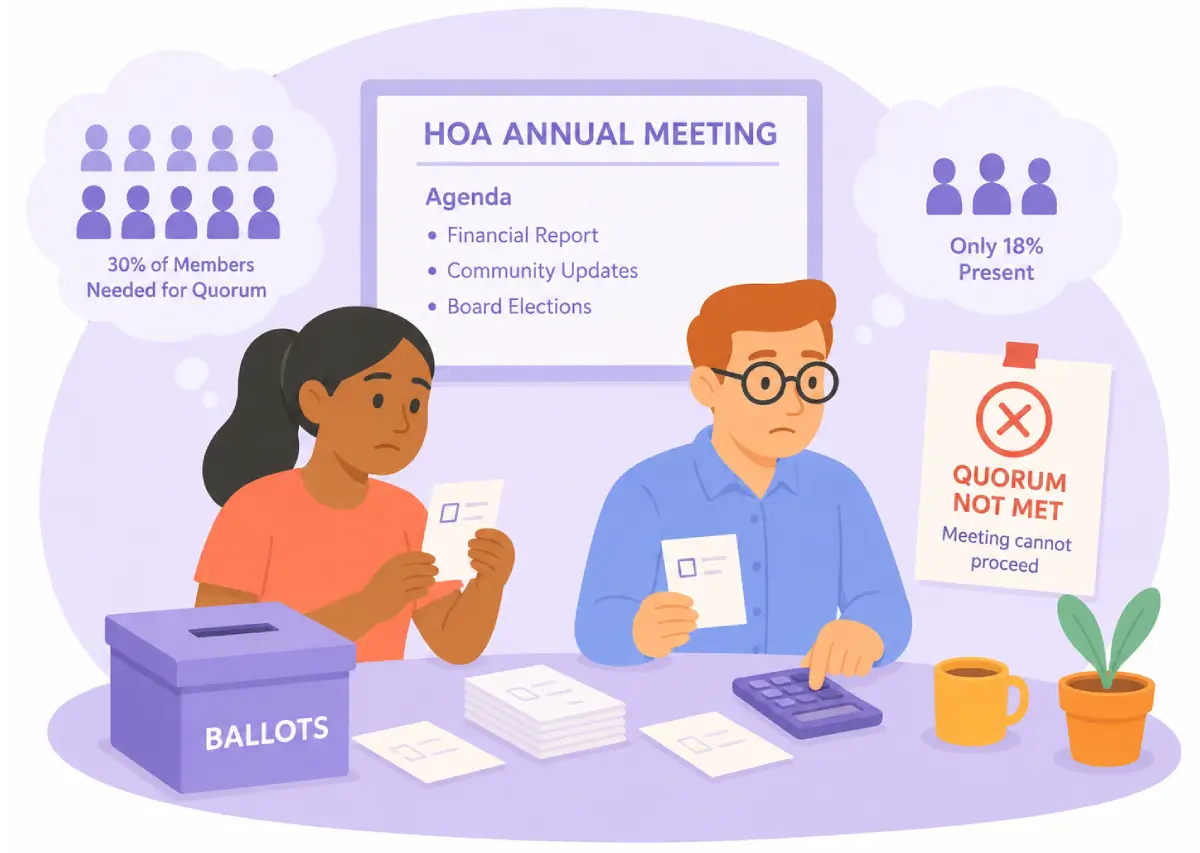
Quorum is rounded up to the next whole unit, since a fraction of a unit cannot be present. This tool does not give legal advice — your threshold, what counts toward it, and whether proxies or ballots qualify are all governed by your own documents and state law.
What these numbers mean
The second figure is the one worth writing on the whiteboard. A 120-unit association with a 25% quorum needs 30 units to participate. At a 30% response rate, that means getting a ballot in front of 100 units — which is only achievable if your contact records cover nearly the whole community. Twenty units with no valid email on file is not a rounding error at that point. It is the difference between a valid meeting and a wasted evening.
How HOA quorum actually works →
Units, not people
In nearly every association the voting interest belongs to the lot, home, or unit — not the human being in the room. A married couple who jointly own one house are one vote. An investor who owns four units casts four. If your roster is a list of email addresses, you cannot calculate quorum from it, because a list of people and a list of units are different objects. Boards that count contacts overstate their denominator and set a threshold they were never going to hit.
Where your threshold comes from
Your bylaws, occasionally constrained by state statute when the documents are silent. There is no national percentage. Thresholds commonly land between 10% and 50% of total voting interests, and developer-drafted documents sometimes specify a figure that a mature, fully-sold community can no longer realistically reach. Some associations also set different thresholds for different business — a lower bar for electing directors, a higher one for amending the declaration.
What counts toward the number
Depending on your documents, a unit may be counted as present in person, by proxy, by written ballot, or electronically. That third item is not universal and it matters enormously: in some associations a returned ballot counts toward quorum, and in others only physical or proxy presence does — meaning a hundred returned ballots still leave you short. Read your bylaws on this specific point before designing your meeting around mail-in voting.
If you miss quorum
The business fails, not the meeting. Motions cannot pass and the election does not occur, so sitting directors typically hold over until successors are elected. But a great many governing documents allow the meeting to be adjourned and reconvened later at a reduced quorum — frequently half the original. That is the single most useful provision most volunteer boards do not know they have. Search your bylaws for "adjourn," "reconvene," and "quorum."
Fuller detail, including how to raise turnout before the meeting rather than during it, is in our guide to HOA quorum at the annual meeting.
Reaching every unit is the hard part
The calculator assumes your notice arrives. A ballot in a spam folder is a unit that did not vote, and it counts against quorum exactly the same as apathy does. Formtabulous tracks which units received a ballot and which have not voted, and measures quorum against the units that actually got one — not against your roster.
See HOA board elections →