What Happens If Your HOA Doesn't Reach Quorum
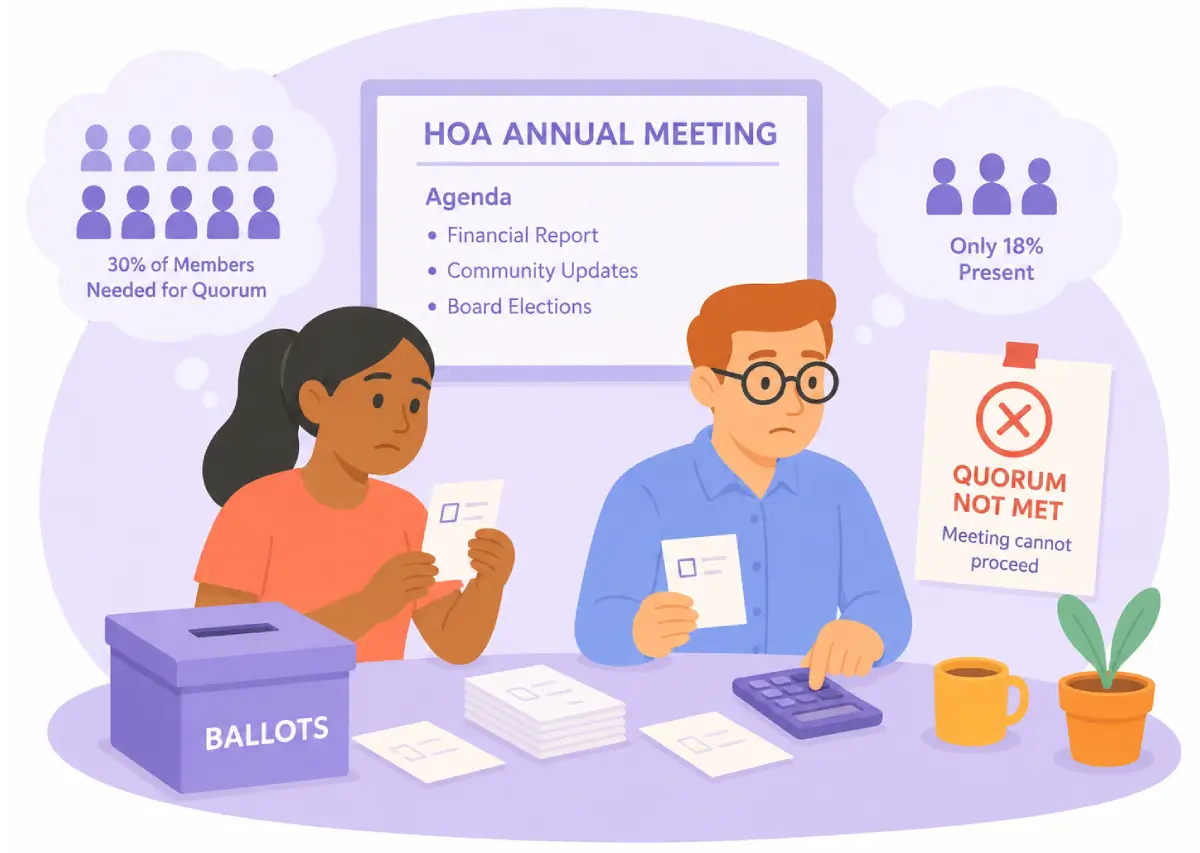
You scheduled the annual meeting, sent the notice, ordered the coffee, and eleven people showed up. Now the board is standing in a clubhouse doing arithmetic on a legal pad, trying to work out whether anything decided tonight actually counts. Missing quorum is the single most common way a self-managed HOA annual meeting fails, and most boards treat it as a turnout problem when it is usually a math problem, a notice problem, or a delivery problem. This guide covers what quorum actually measures, how to calculate it correctly, what happens when you miss it, why reconvened meetings at a reduced quorum exist, and the specific things that move participation before the meeting rather than during it.
TL;DR — HOA quorum in one box
- Quorum is measured in units, not people. Two co-owners of one lot are one vote. A homeowner who owns three lots casts three. Counting heads is the most common way boards get the number wrong.
- Your threshold lives in your bylaws, not in a general rule. Typical figures run from 10% to 50% of units, and some states set a floor or a default when the documents are silent.
- Missing quorum usually voids the business, not the meeting. No binding votes, no valid election, and in most cases the existing board stays seated until a successful election occurs.
- Most bylaws permit a reconvened meeting at a reduced quorum. This is the single most useful provision volunteer boards do not know they have. Check your documents before you panic.
- Turnout is mostly a delivery problem. If forty notices went to spam, you did not have an apathy problem — you had an inbox placement problem that looked like one.
What Quorum Actually Measures
Quorum is the minimum level of member participation required before a meeting can conduct binding business. It exists so that a handful of motivated neighbors cannot make decisions that bind everyone else. It is a floor on legitimacy, not a target for attendance.
Units, not people
This is where most volunteer boards go wrong on the first step. In nearly every association, the voting interest belongs to the lot, home, or unit — not to the human being standing in the room. A married couple who jointly own one house are one vote. An investor who owns four units in the same community casts four. A unit with three names on the deed still gets one ballot.
If your roster is a list of email addresses, you cannot calculate quorum from it, because a list of people and a list of units are different objects. Two hundred contacts might be one hundred and forty units. Boards that count contacts consistently overstate their denominator, set an unreachable threshold, and then conclude their neighbors do not care.
What counts toward the number
Depending on your governing documents, participation typically counts if the unit is represented in any of these ways:
- Present in person at the meeting
- Represented by proxy, where another person is authorized to act for that unit
- By ballot, where the documents allow written or absentee ballots to count toward quorum
- Electronically, where the documents and applicable state law permit it
That third item is not universal, and it matters enormously. In some associations a returned ballot counts toward quorum; in others only physical or proxy presence does, and a hundred returned ballots still leave you short. Read your bylaws on this specific point before you design your annual meeting around mail-in voting.
Where your threshold comes from
There is no national quorum percentage. Your number comes from your bylaws, occasionally constrained or supplied by state statute when the documents are silent. Thresholds commonly land somewhere between 10% and 50% of total voting interests, and it is not unusual for older governing documents drafted by a developer to specify a figure that a mature, fully-sold community can no longer realistically hit.
Some associations also set a different threshold for different business — a lower bar for electing directors, a higher one for amending the declaration or approving a special assessment. Check whether your documents do this before assuming one number covers everything on the agenda.
HOA Quorum Calculator
Enter your total units and your bylaw threshold to see how many units you need. The second figure is the more useful one: given a realistic response rate, how many units you need to actually reach with a ballot or notice in order to get there.
Quorum is rounded up to the next whole unit, since a fraction of a unit cannot be present. Response rate is your own estimate — use last year's actual participation if you have it, and treat anything above 40% for a routine annual meeting as optimistic.
The "units you must reach" figure is the one worth writing on the whiteboard. A 120-unit association with a 25% quorum needs 30 units to participate. At a 30% response rate, that means getting a ballot in front of 100 units — which is only achievable if your contact records cover nearly the whole community and your notices actually arrive. Twenty units with no valid email on file is not a rounding error at that point. It is the difference between a valid meeting and a wasted evening.
Why Boards Miss Quorum
Apathy gets blamed for nearly every failed annual meeting. It is real, but it is rarely the largest factor, and it is the only one on this list a board cannot do anything about. Here is what usually accounts for the gap, roughly in order of how much it costs the typical self-managed association.
1. Stale contact records
The roster was assembled by a board member in 2019 and updated whenever someone remembered. Homes have sold. Email addresses have been abandoned. Nobody knows which entries are dead because nothing tracks bounces. A community that believes it can reach 140 units may in practice reach 105, which quietly moves the effective response rate needed from 25% to 33%.
2. Notices that never arrived
A meeting notice sent by BCC from a personal Gmail account, or through a marketing platform that lands in the Promotions tab, may be technically sent and functionally invisible. Homeowners are not ignoring the notice; they never saw it. This one is insidious because it produces exactly the same evidence as apathy — an empty room — while having a completely different cause and a completely different fix.
3. Counting people instead of units
Covered above, and worth repeating because it is silent. A board that sets its target against a contact count rather than a unit count is aiming at the wrong number from the start and will not discover the error until the night of the meeting.
4. A threshold written for a different community
Developer-drafted bylaws often specify a quorum that made sense when the developer controlled most of the votes and could produce it single-handedly. Twenty years later, with 300 independent owners, a 50% quorum requires a level of civic participation almost no residential community achieves. If your association has missed quorum three years running, the problem may not be this year's outreach.
5. Notice that is technically valid but practically useless
A notice mailed exactly the minimum number of days in advance, with no reminder, gives every homeowner one chance to notice it and act. Boards that hit quorum reliably almost always send an initial notice, at least one reminder, and a final call — and they make participating possible without attending in person.
6. Genuine disengagement
Some of it is real. Renters-heavy communities, absentee owners, and associations that have never had a contested issue tend to have low baseline participation. This is the portion worth accepting rather than fighting, and it is the reason reduced-quorum provisions exist.
What Happens If Your HOA Doesn't Reach Quorum
The specifics come from your governing documents and your state's statutes, but the general shape is consistent across most associations.
The business fails, not the meeting
Without quorum, the assembled members cannot transact binding business. Motions cannot be passed. Budgets requiring member ratification cannot be ratified. Amendments cannot be adopted. The board can still hold the gathering, give reports, take questions, and adjourn — many boards do exactly that, and it is a reasonable use of the evening — but nothing voted on is enforceable.
The election does not happen
This is the consequence with the longest tail. If directors cannot be elected, most governing documents provide that sitting directors hold over until their successors are elected and qualified. In practice that means a board member who wanted to step down cannot, and a community that wanted new leadership does not get it. Holdover boards are a common and demoralizing outcome of repeated quorum failures.
Some things continue regardless
Failing to reach quorum at an annual meeting generally does not suspend the association. Assessments remain due. The board retains the authority the documents give it to conduct ordinary business without a member vote — routine maintenance, vendor contracts within its spending authority, enforcement of existing rules. What is lost is the member-level decision-making that specifically requires a vote of the ownership.
Anything voted on anyway is vulnerable
A board that proceeds to a vote without quorum, whether from misunderstanding or impatience, creates a decision any owner can later challenge. That challenge may arrive years afterward, attached to something else entirely — a disputed assessment, an enforcement action, a sale. It is worth adjourning rather than improvising.
Reconvened Meetings and Reduced Quorum
Here is the provision most volunteer boards do not know they have. A great many governing documents state that if quorum is not achieved at a properly noticed meeting, the meeting may be adjourned and reconvened at a later date with a lower quorum requirement — frequently half the original, sometimes a fixed smaller percentage, occasionally with the requirement effectively removed.
The reasoning is practical. Owners who repeatedly decline to participate should not be able to paralyze the association indefinitely by doing nothing. The reduced quorum is the release valve that lets a community with low engagement still elect a board.
What to check in your documents
- Whether the provision exists at all. It is common but not universal. Search your bylaws for "adjourn," "reconvene," and "quorum."
- What the reduced threshold is. Half the original is typical. Some documents specify a flat percentage instead.
- What notice the reconvened meeting requires. Some documents allow announcing the new date at the adjourned meeting; others require fresh written notice with a full notice period.
- Whether the reduction applies to everything. It often covers elections and routine business but not amendments to the declaration or special assessments.
- Whether it can be used repeatedly. Most documents contemplate one reconvening, not an indefinite chain.
Practical tip: boards that expect a quorum problem sometimes notice the original meeting and the potential reconvened date together, in the same communication, where their documents permit it. Homeowners get both dates up front, and the board is not scrambling to re-notice a second meeting on short turnaround. Whether this is allowed depends entirely on your notice provisions — confirm before relying on it.
Proxies, Ballots, and Electronic Voting
These three mechanisms all let a unit participate without a person physically attending, and boards routinely confuse them. They are not interchangeable, and your documents may permit one and not another.
Proxies
A proxy authorizes another person to act on behalf of the unit at the meeting. Depending on the documents it may be general, giving the holder discretion, or directed, instructing the holder how to vote on specified matters. Proxies almost always count toward quorum, which is precisely why boards facing a shortfall solicit them. They also tend to carry formal requirements — a signature, a defined expiration, sometimes a limit on how many proxies one person may hold.
Ballots
A ballot is a direct vote cast by the unit itself, without a representative. The critical question, and the one boards most often get wrong, is whether a returned ballot counts toward quorum in your association. In some it does, and mail-in voting is a complete solution to a turnout problem. In others quorum requires presence or proxy, and a stack of returned ballots does not help you convene.
Electronic voting
Several states have moved to authorize electronic voting for community associations, generally with conditions attached — owner consent to vote electronically, protections for ballot secrecy, and in some cases specific balloting procedures that an electronic system must replicate. Others have no statute, which leaves the question to the governing documents and to counsel.
Because this area has been changing and the rules differ materially between states, treat any general article on the subject as orientation rather than authority. Before running a binding election electronically, read your CC&Rs and bylaws, check your state's current statute, and confirm the method with your association attorney.
How to Actually Raise Participation
Turnout is won in the four weeks before the meeting, not in the room. What follows is ordered by effect per hour of volunteer effort.
Fix the roster before you send anything
Build a list of units, assign owners to them, and identify every unit with no valid contact. That count is your ceiling. A board that discovers eighteen uncovered units six weeks out can knock on eighteen doors; a board that discovers it the night of the meeting cannot. This is unglamorous and it is the highest-return thing on the list.
Send more than once
An initial notice, a reminder roughly a week out, and a final call the day before is a reasonable cadence. Each touch reaches people the previous one missed — different schedules, different inbox habits, different levels of attention. Boards that send once and blame apathy are measuring their own outreach, not their neighbors' interest.
Tell people what is actually at stake
"Annual meeting, 7pm, clubhouse" is a calendar entry, not a reason. "Three board seats are open and we need 30 of our 120 homes to participate or we cannot hold the election" gives a homeowner both a stake and a specific, achievable thing to do. Publishing the running participation count in reminders works for the same reason a fundraising thermometer does.
Make participating possible without attending
The largest single barrier is that 7pm on a Tuesday does not work for a meaningful share of any community. Whatever your documents permit — proxies, absentee ballots, electronic voting — use it, and make the instructions short enough to follow on a phone. Every step between a homeowner's intention and their recorded participation loses some of them.
Tell non-participants afterward that they did not participate
Send the outcome to everyone, including the units that did not vote, and say plainly that their unit did not participate and that every unit counts toward quorum. It is a low-effort message that measurably improves the following year, and almost no board sends it.
Quorum Is Partly a Deliverability Problem
A ballot in a spam folder is a unit that did not vote, and a unit that did not vote counts against quorum. The failure is invisible: nothing bounces, nobody complains, and the board has no way to distinguish a homeowner who ignored the notice from one who never received it. Both produce the same empty seat.
Since February 2024, Gmail and Yahoo have expected senders to authenticate with SPF, DKIM, and DMARC, offer one-click unsubscribe, and keep spam complaints low. A volunteer board BCC-ing 140 homeowners from a personal account trips several of those signals at once, and a board using a marketing platform gets filed in the Promotions tab by design. Neither outcome announces itself.
The practical implications for an annual meeting are concrete. Send from authenticated infrastructure. Track bounces and know which units are unreachable before you set your expectations, not after. And check delivery per unit rather than per contact, since a unit whose only listed owner has a dead address is a unit you have lost regardless of how many other addresses you hold. More on why community email goes to spam →
How Formtabulous handles it
Formtabulous Board Elections is built around the unit as the unit of account. You maintain a registry of units, assign owners to them, and designate one primary contact per unit as the ballot holder — the system refuses to make an unsubscribed or invalid address primary, because that silently costs the unit its vote.
Quorum is set as a percentage of units or a fixed count, and measured against the units that actually received a ballot rather than a roster figure. Before ballots go out, the board is shown exactly which units will not receive one, why, and what that does to the threshold, with a link to fix the assignments while there is still time. During voting the board sees participation but not vote counts, so a running tally cannot influence the owners still deciding. If turnout falls short, the deadline can be extended — capped, and with automatic notice to every unit that has not yet voted.
If quorum fails anyway, the results are labeled as a record rather than an outcome, no winners are marked, and the board is pointed toward its governing documents for the reconvened-meeting provision. Ballots are delivered through the same authenticated infrastructure as the rest of your HOA email, which is the part that makes the rest of it worth doing.
Build your unit registry before election season
The registry is the part that takes an afternoon and the part every board wishes it had done in March. Formtabulous includes board elections on every plan, including the free one — no per-unit fee, no per-election fee.
This article is general information about how HOA quorum requirements typically work, not legal advice. Quorum thresholds, reconvened-meeting provisions, proxy rules, and the permissibility of electronic voting are governed by your association's own documents and by state law, both of which vary substantially and change over time. Confirm anything consequential with your association attorney.
Frequently Asked Questions
What is quorum for an HOA meeting?
Quorum is the minimum share of voting interests that must participate before a meeting can conduct binding business. It is measured in units — lots, homes, or addresses — rather than in people, so two co-owners of one house represent one vote and an owner of three lots represents three. There is no national standard percentage; your threshold comes from your bylaws, and is sometimes constrained or supplied by state statute when the documents are silent. Thresholds commonly fall between 10% and 50% of total voting interests.
How do I calculate HOA quorum?
Multiply your total voting units by your bylaw percentage and round up to the next whole unit. A 120-unit association with a 25% quorum needs 30 units to participate. The more useful second calculation is how many units you must actually reach to get there: divide the quorum number by your expected response rate. At a 30% response rate, reaching 30 units means getting a ballot or notice in front of 100 units — which is only possible if your contact records cover nearly the whole community.
What happens if an HOA annual meeting doesn't reach quorum?
The meeting cannot conduct binding business. Motions cannot pass, budgets requiring member ratification cannot be ratified, and the board election does not occur. In most associations, sitting directors hold over until successors are elected and qualified, so the existing board remains seated. The association itself continues to operate — assessments remain due and the board keeps the ordinary authority its documents grant it. Anything voted on without quorum is vulnerable to challenge later, so adjourning is generally safer than proceeding.
Can an HOA lower its quorum requirement?
Not unilaterally, but many governing documents already contain a reduced-quorum provision. If quorum is not achieved at a properly noticed meeting, the documents frequently allow the meeting to be adjourned and reconvened later at a lower threshold — often half the original. Search your bylaws for "adjourn," "reconvene," and "quorum." Check what notice the reconvened meeting requires, whether the reduction applies to all business or only to elections and routine matters, and whether it can be used more than once. Permanently changing the threshold itself normally requires amending the bylaws, which typically demands a higher vote than the one you were unable to obtain.
Do proxies count toward HOA quorum?
In most associations, yes — a proxy authorizes another person to act for the unit at the meeting, and the unit is therefore represented. This is why boards facing a shortfall solicit proxies. Proxies usually carry formal requirements set by the governing documents: a signature, a stated expiration, sometimes a cap on how many one person may hold, and sometimes a distinction between general proxies and directed ones. Confirm your association's specific rules before relying on them.
Do mail-in or electronic ballots count toward quorum?
It depends entirely on your governing documents, and this is one of the most commonly misunderstood points in HOA governance. In some associations a returned ballot counts toward quorum, which makes absentee voting a complete solution to a turnout problem. In others, quorum requires presence in person or by proxy, and a large stack of returned ballots still leaves the meeting unable to convene. Read your bylaws on this specific question before designing an annual meeting around mail-in or electronic voting.
Is quorum counted by units or by homeowners?
By units, in nearly every association. The voting interest attaches to the lot, home, or unit rather than to the individual, so a married couple who jointly own one house represent one vote, and an investor who owns four units represents four. This matters practically because a contact list and a unit list are different objects — 200 email addresses might represent 140 units. Boards that calculate quorum from a contact count overstate their denominator and set a threshold they were never going to hit.
How can our HOA improve annual meeting turnout?
Start by auditing the roster: build a list of units, assign owners, and count the units with no valid contact — that number is your ceiling, and it is fixable weeks in advance but not on the night. Then send more than once, with an initial notice, a reminder about a week out, and a final call. Say what is at stake and what the specific target is rather than just giving a date and time. Use whatever your documents permit for participating without attending, since a weekday evening excludes a meaningful share of any community. Finally, tell non-participants afterward that their unit did not participate and that every unit counts toward quorum — it is a low-effort message that measurably improves the following year.
Can a ballot going to spam cause an HOA to miss quorum?
Yes, and it is a common hidden cause. A ballot filtered to spam or routed to Gmail's Promotions tab produces exactly the same result as apathy — an absent unit — while having a completely different cause. Nothing bounces and nobody complains, so the board has no signal that anything went wrong. Sending from infrastructure authenticated with SPF, DKIM, and DMARC, tracking bounces so unreachable units are known in advance, and checking delivery per unit rather than per contact all reduce the gap between units you believe you can reach and units you actually reach.